Archives AI News

The Pixel 10’s AI screamed at us

257915 vergecast CVirginia VRG 0207 Site

This seems to be the year that Google's AI features are actually starting to add up to something useful. After a week testing the Pixel 10 Pro, my colleagues Allison Johnson and Vee Song say some of the new features are legitimately useful - at least when they work, which isn't always as expected. Case […]

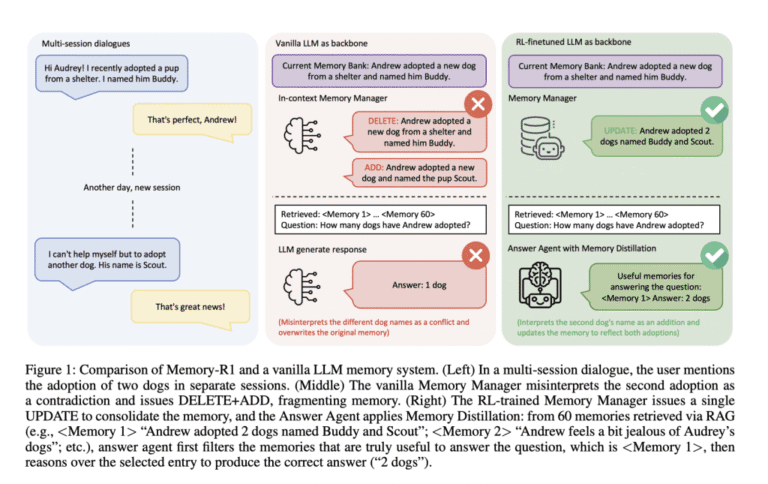
Memory-R1: How Reinforcement Learning Supercharges LLM Memory Agents

Screenshot 2025 08 28 at 8.46.42 PM 1 1024x645 1

Large language models (LLMs) now stand at the center of countless AI breakthroughs—chatbots, coding assistants, question answering, creative writing, and much more. But despite their prowess, they remain stateless: each query arrives with no memory of what came before. Their fixed context windows mean they can’t accumulate persistent knowledge across long conversations or multi-session tasks, […] The post Memory-R1: How Reinforcement Learning Supercharges LLM Memory Agents appeared first on MarkTechPost.

Stochastic Gradients under Nuisances

arXiv:2508.20326v1 Announce Type: new Abstract: Stochastic gradient optimization is the dominant learning paradigm for a variety of scenarios, from classical supervised learning to modern self-supervised learning. We consider stochastic gradient algorithms for learning problems whose objectives rely on unknown nuisance parameters, and establish non-asymptotic convergence guarantees. Our results show that, while the presence of a nuisance can alter the optimum and upset the optimization trajectory, the classical stochastic gradient algorithm may still converge under appropriate conditions, such as Neyman orthogonality. Moreover, even when Neyman orthogonality is not satisfied, we show that an algorithm variant with approximately orthogonalized updates (with an approximately orthogonalized gradient oracle) may achieve similar convergence rates. Examples from orthogonal statistical learning/double machine learning and causal inference are discussed.

Distributed optimization: designed for federated learning

arXiv:2508.08606v2 Announce Type: replace-cross Abstract: Federated Learning (FL), as a distributed collaborative Machine Learning (ML) framework under privacy-preserving constraints, has garnered increasing research attention in cross-organizational data collaboration scenarios. This paper proposes a class of distributed optimization algorithms based on the augmented Lagrangian technique, designed to accommodate diverse communication topologies in both centralized and decentralized FL settings. Furthermore, we develop multiple termination criteria and parameter update mechanisms to enhance computational efficiency, accompanied by rigorous theoretical guarantees of convergence. By generalizing the augmented Lagrangian relaxation through the incorporation of proximal relaxation and quadratic approximation, our framework systematically recovers a broad of classical unconstrained optimization methods, including proximal algorithm, classic gradient descent, and stochastic gradient descent, among others. Notably, the convergence properties of these methods can be naturally derived within the proposed theoretical framework. Numerical experiments demonstrate that the proposed algorithm exhibits strong performance in large-scale settings with significant statistical heterogeneity across clients.

High-Dimensional Gaussian Process Regression with Soft Kernel Interpolation

arXiv:2410.21419v3 Announce Type: replace Abstract: We introduce Soft Kernel Interpolation (SoftKI), a method that combines aspects of Structured Kernel Interpolation (SKI) and variational inducing point methods, to achieve scalable Gaussian Process (GP) regression on high-dimensional datasets. SoftKI approximates a kernel via softmax interpolation from a smaller number of interpolation points learned by optimizing a combination of the SoftKI marginal log-likelihood (MLL), and when needed, an approximate MLL for improved numerical stability. Consequently, it can overcome the dimensionality scaling challenges that SKI faces when interpolating from a dense and static lattice while retaining the flexibility of variational methods to adapt inducing points to the dataset. We demonstrate the effectiveness of SoftKI across various examples and show that it is competitive with other approximated GP methods when the data dimensionality is modest (around 10).

Balancing Interference and Correlation in Spatial Experimental Designs: A Causal Graph Cut Approach

arXiv:2505.20130v3 Announce Type: replace-cross Abstract: This paper focuses on the design of spatial experiments to optimize the amount of information derived from the experimental data and enhance the accuracy of the resulting causal effect estimator. We propose a surrogate function for the mean squared error (MSE) of the estimator, which facilitates the use of classical graph cut algorithms to learn the optimal design. Our proposal offers three key advances: (1) it accommodates moderate to large spatial interference effects; (2) it adapts to different spatial covariance functions; (3) it is computationally efficient. Theoretical results and numerical experiments based on synthetic environments and a dispatch simulator that models a city-scale ridesharing market, further validate the effectiveness of our design. A python implementation of our method is available at https://github.com/Mamba413/CausalGraphCut.

Fast Convergence Rates for Subsampled Natural Gradient Algorithms on Quadratic Model Problems

arXiv:2508.21022v1 Announce Type: cross Abstract: Subsampled natural gradient descent (SNGD) has shown impressive results for parametric optimization tasks in scientific machine learning, such as neural network wavefunctions and physics-informed neural networks, but it has lacked a theoretical explanation. We address this gap by analyzing the convergence of SNGD and its accelerated variant, SPRING, for idealized parametric optimization problems where the model is linear and the loss function is strongly convex and quadratic. In the special case of a least-squares loss, namely the standard linear least-squares problem, we prove that SNGD is equivalent to a regularized Kaczmarz method while SPRING is equivalent to an accelerated regularized Kaczmarz method. As a result, by leveraging existing analyses we obtain under mild conditions (i) the first fast convergence rate for SNGD, (ii) the first convergence guarantee for SPRING in any setting, and (iii) the first proof that SPRING can accelerate SNGD. In the case of a general strongly convex quadratic loss, we extend the analysis of the regularized Kaczmarz method to obtain a fast convergence rate for SNGD under stronger conditions, providing the first explanation for the effectiveness of SNGD outside of the least-squares setting. Overall, our results illustrate how tools from randomized linear algebra can shed new light on the interplay between subsampling and curvature-aware optimization strategies.


LASE: Learned Adjacency Spectral Embeddings

arXiv:2412.17734v2 Announce Type: replace-cross Abstract: We put forth a principled design of a neural architecture to learn nodal Adjacency Spectral Embeddings (ASE) from graph inputs. By bringing to bear the gradient descent (GD) method and leveraging the principle of algorithm unrolling, we truncate and re-interpret each GD iteration as a layer in a graph neural network (GNN) that is trained to approximate the ASE. Accordingly, we call the resulting embeddings and our parametric model Learned ASE (LASE), which is interpretable, parameter efficient, robust to inputs with unobserved edges, and offers controllable complexity during inference. LASE layers combine Graph Convolutional Network (GCN) and fully-connected Graph Attention Network (GAT) modules, which is intuitively pleasing since GCN-based local aggregations alone are insufficient to express the sought graph eigenvectors. We propose several refinements to the unrolled LASE architecture (such as sparse attention in the GAT module and decoupled layerwise parameters) that offer favorable approximation error versus computation tradeoffs; even outperforming heavily-optimized eigendecomposition routines from scientific computing libraries. Because LASE is a differentiable function with respect to its parameters as well as its graph input, we can seamlessly integrate it as a trainable module within a larger (semi-)supervised graph representation learning pipeline. The resulting end-to-end system effectively learns ``discriminative ASEs'' that exhibit competitive performance in supervised link prediction and node classification tasks, outperforming a GNN even when the latter is endowed with open loop, meaning task-agnostic, precomputed spectral positional encodings.