Trump Seeks to Cancel CHIPS Act R&D Organization’s Funds
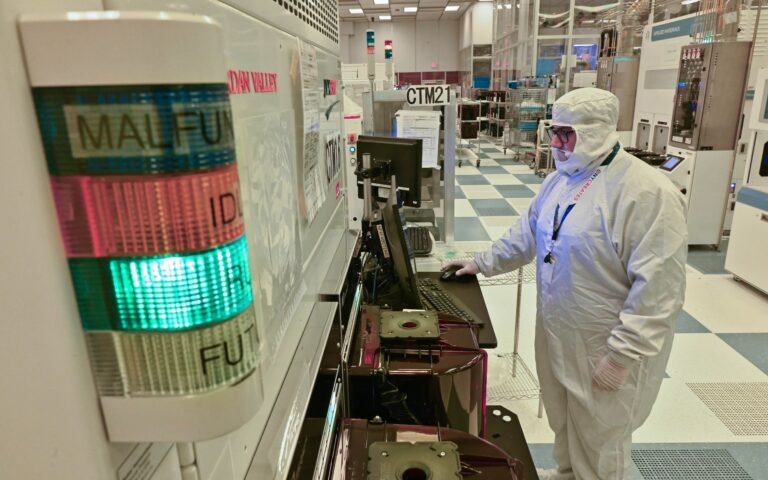
The U.S. Commerce Department says it will not abide by an agreement to fund the U.S. CHIPS and Science Act’s R&D through the nonprofit set up to administer the program, called Natcast. Instead, it handed operational control to the National Institute of Standards and Technology (NIST).Natcast was created in 2023 to oversee the National Semiconductor Technology Center (NSTC), which the law established to conduct “research and prototyping of advanced semiconductor technology and grow the domestic semiconductor workforce to strengthen the economic competitiveness and security of the domestic supply chain.” The nonprofit was contracted to receive a total of US $7.4 billion, in annual payments and when the organization reaches milestones. But Commerce Secretary Howard Lutnick claimed that Natcast doesn’t meet certain legal requirements, and therefore the contract, inked less than a week before Donald J. Trump took office for the second time, is illegal. Several NSTC proponents whom IEEE Spectrum spoke to are concerned that the move could squander U.S. semiconductor leadership in the long term. The goal of the NSTC, those involved say, is to make gains in semiconductors from the CHIPS Act durable through continued advances. Since its establishment, Natcast has been working to bring up three key centers to execute those functions. In Silicon Valley, it’s established a workforce development and design enablement center. In New York, it opened a center for extreme-ultraviolet lithography for cutting edge chipmaking. And in Arizona, it plans to build a prototyping and packaging facility. The centers are intended to help startups and other companies more easily bridge the lab-to-fab gap that currently prevents new technologies from making it into commercial products.“There were people from day one…who viewed [Natcast] as very much a political entity and wanted to undo it”The CHIPS Act requires that the NSTC be operated as a “public private-sector consortium with participation from the private sector” instead of by a government agency. During the Biden administration, the Commerce Department created Natcast to fill that role, deliberately setting it up in a way to help maintain its independence from political interference. In a public letter to Natcast CEO Deirdre Hanford, Lutnick cast the actions of Hanford, her staff, and the volunteer advisors involved in the organization’s creation as giving “the appearance of impropriety” and flouting “federal law.” “From the very beginning Natcast served as a semiconductor slush fund that did nothing but line the pockets of Biden loyalists with American tax dollars,” he said in a press release.(IEEE Spectrum sought additional comment from the Commerce Department and from Natcast but did not receive a reply by press time.)Very little funding has actually been delivered, sources say, in part because Commerce has held up its dispersal. (Despite this, NSTC does have a list of accomplishments and is planning a symposium in September at which it will unveil its research agenda.) Lutnick’s legal argument for refusing payment now is that Natcast wasn’t established in accordance with the Government Corporation Control Act, which lays out how government agencies establish or purchase corporations. One person familiar with the situation who asked not to be named says that the structure of Natcast is typical of public-private partnerships and that its underpinnings were thoroughly reviewed by the Commerce Department before its establishment. What’s really at issue, this person says, is Natcast’s independence.“What was set up… was always designed with a long-term strategy in mind. I don’t think they’ll get that back…. I think all of that has gone away with this decision”“There were people from day one…who viewed [Natcast] as very much a political entity and wanted to undo it,” says this person.In the letter, Lutnick takes aim at Hanford, formerly a top executive at electronic design automation giant Synopsys, as well as at Natcast staffers who came over from government during the Biden administration or from a volunteer industrial advisory committee that included IEEE Fellows and other chip industry leaders. Targeting such people is concerning, says one expert who preferred not to be named, because chip experts who choose to work in government or at Natcast are usually giving up more lucrative work to serve their country. It has the effect of “punishing patriotic behavior,” the expert said.Delaying the work of the NSTC by attacking Natcast is counterproductive for the U.S. chip industry, the expert added. “We are in a race, and these delays make it all the more urgent.”Commerce will likely find some way to spend the money on semiconductor R&D eventually, sources agreed. One expert told Spectrum they have faith in NIST’s ability to administer the research funding. Mark Granahan, an early proponent of the CHIPS Act and CEO of Ideal Semiconductor, in Bethlehem, Penn., went further. “If the administration has a different tactic but the same goal… not just independence in semiconductors but leadership… then NIST and other existing infrastructure is capable of handling things,” he said.But other sources were skeptical it would have the same impact as Natcast. “What was set up… was always designed with a long-term strategy in mind,” said one person. “I don’t think they’ll get that back…. I think all of that has gone away with this decision.”