Archives AI News

Lenovo leaks show concept laptop with rotating display

Lenovo Project Pivo leak

Lenovo is gearing up to show off its latest products at Europe’s IFA tech tradeshow next week, but leaks may have just given us a first look at what’s being announced. The most notable gadget shared by reputable leaker Evan Blass shows an image of a concept laptop design with a display that rotates between […]

The Pixel 10’s AI screamed at us

257915 vergecast CVirginia VRG 0207 Site

This seems to be the year that Google's AI features are actually starting to add up to something useful. After a week testing the Pixel 10 Pro, my colleagues Allison Johnson and Vee Song say some of the new features are legitimately useful - at least when they work, which isn't always as expected. Case […]

Distributed optimization: designed for federated learning

arXiv:2508.08606v2 Announce Type: replace-cross Abstract: Federated Learning (FL), as a distributed collaborative Machine Learning (ML) framework under privacy-preserving constraints, has garnered increasing research attention in cross-organizational data collaboration scenarios. This paper proposes a class of distributed optimization algorithms based on the augmented Lagrangian technique, designed to accommodate diverse communication topologies in both centralized and decentralized FL settings. Furthermore, we develop multiple termination criteria and parameter update mechanisms to enhance computational efficiency, accompanied by rigorous theoretical guarantees of convergence. By generalizing the augmented Lagrangian relaxation through the incorporation of proximal relaxation and quadratic approximation, our framework systematically recovers a broad of classical unconstrained optimization methods, including proximal algorithm, classic gradient descent, and stochastic gradient descent, among others. Notably, the convergence properties of these methods can be naturally derived within the proposed theoretical framework. Numerical experiments demonstrate that the proposed algorithm exhibits strong performance in large-scale settings with significant statistical heterogeneity across clients.

Stochastic Gradients under Nuisances

arXiv:2508.20326v1 Announce Type: new Abstract: Stochastic gradient optimization is the dominant learning paradigm for a variety of scenarios, from classical supervised learning to modern self-supervised learning. We consider stochastic gradient algorithms for learning problems whose objectives rely on unknown nuisance parameters, and establish non-asymptotic convergence guarantees. Our results show that, while the presence of a nuisance can alter the optimum and upset the optimization trajectory, the classical stochastic gradient algorithm may still converge under appropriate conditions, such as Neyman orthogonality. Moreover, even when Neyman orthogonality is not satisfied, we show that an algorithm variant with approximately orthogonalized updates (with an approximately orthogonalized gradient oracle) may achieve similar convergence rates. Examples from orthogonal statistical learning/double machine learning and causal inference are discussed.

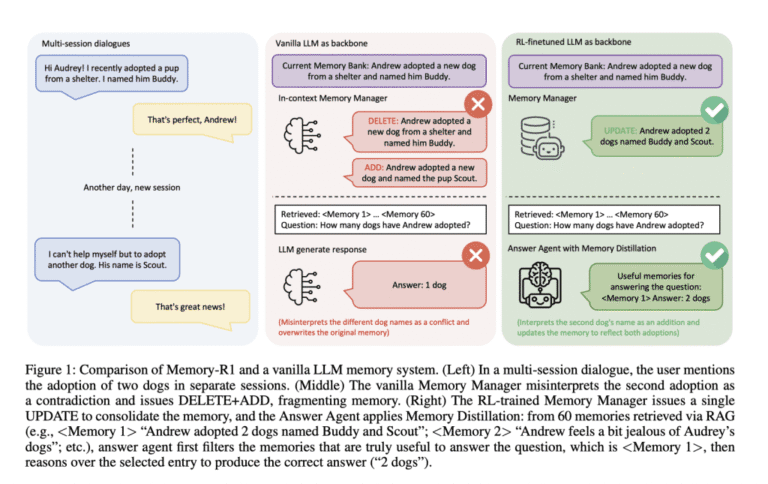
Memory-R1: How Reinforcement Learning Supercharges LLM Memory Agents

Screenshot 2025 08 28 at 8.46.42 PM 1 1024x645 1

Large language models (LLMs) now stand at the center of countless AI breakthroughs—chatbots, coding assistants, question answering, creative writing, and much more. But despite their prowess, they remain stateless: each query arrives with no memory of what came before. Their fixed context windows mean they can’t accumulate persistent knowledge across long conversations or multi-session tasks, […] The post Memory-R1: How Reinforcement Learning Supercharges LLM Memory Agents appeared first on MarkTechPost.

A Hierarchical Signal Coordination and Control System Using a Hybrid Model-based and Reinforcement Learning Approach

arXiv:2508.20102v1 Announce Type: cross Abstract: Signal control in urban corridors faces the dual challenge of maintaining arterial traffic progression while adapting to demand variations at local intersections. We propose a hierarchical traffic signal coordination and control scheme that integrates model-based optimization with reinforcement learning. The system consists of: (i) a High-Level Coordinator (HLC) that selects coordination strategies based on observed and predicted demand; (ii) a Corridor Coordinator that derives phase constraints from the selected strategy-either Max-Flow Coordination (MFC) or Green-Wave Coordination (GWC); and (iii) Hybrid Signal Agents (HSAs) that determine signal phases via reinforcement learning with action masking to enforce feasibility. Hierarchical reinforcement learning with Proximal Policy Optimization (PPO) is used to train HSA and HLC policies. At the lower level, three HSA policies-MFC-aware, GWC-aware, and pure agent control (PAC) are trained in conjunction with their respective coordination strategies. At the higher level, the HLC is trained to dynamically switch strategies using a multi-objective reward balancing corridor-level and network-wide performance. The proposed scheme was developed and evaluated on a SUMO-RLlib platform. Case results show that hybrid MFC maximizes throughput under heavy demand; hybrid GWC consistently minimizes arterial stops and maintains progression across diverse traffic conditions but can reduce network-wide efficiency; and PAC improves network-wide travel time in moderate demand but is less effective under heavy demand. The hierarchical design enables adaptive strategy selection, achieving robust performance across all demand levels.

Provable Benefits of In-Tool Learning for Large Language Models

arXiv:2508.20755v1 Announce Type: cross Abstract: Tool-augmented language models, equipped with retrieval, memory, or external APIs, are reshaping AI, yet their theoretical advantages remain underexplored. In this paper, we address this question by demonstrating the benefits of in-tool learning (external retrieval) over in-weight learning (memorization) for factual recall. We show that the number of facts a model can memorize solely in its weights is fundamentally limited by its parameter count. In contrast, we prove that tool-use enables unbounded factual recall via a simple and efficient circuit construction. These results are validated in controlled experiments, where tool-using models consistently outperform memorizing ones. We further show that for pretrained large language models, teaching tool-use and general rules is more effective than finetuning facts into memory. Our work provides both a theoretical and empirical foundation, establishing why tool-augmented workflows are not just practical, but provably more scalable.

Deep Reinforcement Learning for Optimal Asset Allocation Using DDPG with TiDE

arXiv:2508.20103v1 Announce Type: cross Abstract: The optimal asset allocation between risky and risk-free assets is a persistent challenge due to the inherent volatility in financial markets. Conventional methods rely on strict distributional assumptions or non-additive reward ratios, which limit their robustness and applicability to investment goals. To overcome these constraints, this study formulates the optimal two-asset allocation problem as a sequential decision-making task within a Markov Decision Process (MDP). This framework enables the application of reinforcement learning (RL) mechanisms to develop dynamic policies based on simulated financial scenarios, regardless of prerequisites. We use the Kelly criterion to balance immediate reward signals against long-term investment objectives, and we take the novel step of integrating the Time-series Dense Encoder (TiDE) into the Deep Deterministic Policy Gradient (DDPG) RL framework for continuous decision-making. We compare DDPG-TiDE with a simple discrete-action Q-learning RL framework and a passive buy-and-hold investment strategy. Empirical results show that DDPG-TiDE outperforms Q-learning and generates higher risk adjusted returns than buy-and-hold. These findings suggest that tackling the optimal asset allocation problem by integrating TiDE within a DDPG reinforcement learning framework is a fruitful avenue for further exploration.

The Joys of Categorical Conformal Prediction

arXiv:2507.04441v3 Announce Type: replace Abstract: Conformal prediction (CP) is an Uncertainty Representation technique that delivers finite-sample calibrated prediction regions for any underlying Machine Learning model. Its status as an Uncertainty Quantification (UQ) tool, though, has remained conceptually opaque: While Conformal Prediction Regions (CPRs) give an ordinal representation of uncertainty (larger regions typically indicate higher uncertainty), they lack the capability to cardinally quantify it (twice as large regions do not imply twice the uncertainty). We adopt a category-theoretic approach to CP -- framing it as a morphism, embedded in a commuting diagram, of two newly-defined categories -- that brings us three joys. First, we show that -- under minimal assumptions -- CP is intrinsically a UQ mechanism, that is, its cardinal UQ capabilities are a structural feature of the method. Second, we demonstrate that CP bridges the Bayesian, frequentist, and imprecise probabilistic approaches to predictive statistical reasoning. Finally, we show that a CPR is the image of a covariant functor. This observation is relevant to AI privacy: It implies that privacy noise added locally does not break the global coverage guarantee.