
Archives AI News

Learning functions through Diffusion Maps

arXiv:2509.03758v1 Announce Type: new Abstract: We propose a data-driven method for approximating real-valued functions on smooth manifolds, building on the Diffusion Maps framework under the manifold hypothesis. Given pointwise evaluations of a function, the method constructs a smooth extension to the ambient space by exploiting diffusion geometry and its connection to the heat equation and the Laplace-Beltrami operator. To address the computational challenges of high-dimensional data, we introduce a dimensionality reduction strategy based on the low-rank structure of the distance matrix, revealed via singular value decomposition (SVD). In addition, we develop an online updating mechanism that enables efficient incorporation of new data, thereby improving scalability and reducing computational cost. Numerical experiments, including applications to sparse CT reconstruction, demonstrate that the proposed methodology outperforms classical feedforward neural networks and interpolation methods in terms of both accuracy and efficiency.
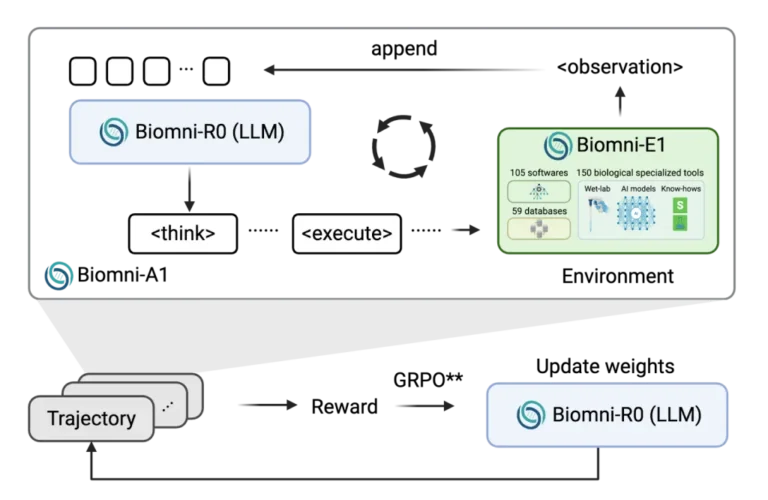
Biomni-R0: New Agentic LLMs Trained End-to-End with Multi-Turn Reinforcement Learning for Expert-Level Intelligence in Biomedical Research

image 11 1024x666 1

The Growing Role of AI in Biomedical Research The field of biomedical artificial intelligence is evolving rapidly, with increasing demand for agents capable of performing tasks that span genomics, clinical diagnostics, and molecular biology. These agents aren’t merely designed to retrieve facts; they are expected to reason through complex biological problems, interpret patient data, and […] The post Biomni-R0: New Agentic LLMs Trained End-to-End with Multi-Turn Reinforcement Learning for Expert-Level Intelligence in Biomedical Research appeared first on MarkTechPost.

Towards understanding Accelerated Stein Variational Gradient Flow — Analysis of Generalized Bilinear Kernels for Gaussian target distributions

arXiv:2509.04008v1 Announce Type: cross Abstract: Stein variational gradient descent (SVGD) is a kernel-based and non-parametric particle method for sampling from a target distribution, such as in Bayesian inference and other machine learning tasks. Different from other particle methods, SVGD does not require estimating the score, which is the gradient of the log-density. However, in practice, SVGD can be slow compared to score-estimation-based sampling algorithms. To design a fast and efficient high-dimensional sampling algorithm with the advantages of SVGD, we introduce accelerated SVGD (ASVGD), based on an accelerated gradient flow in a metric space of probability densities following Nesterov's method. We then derive a momentum-based discrete-time sampling algorithm, which evolves a set of particles deterministically. To stabilize the particles' position update, we also include a Wasserstein metric regularization. This paper extends the conference version cite{SL2025}. For the bilinear kernel and Gaussian target distributions, we study the kernel parameter and damping parameters with an optimal convergence rate of the proposed dynamics. This is achieved by analyzing the linearized accelerated gradient flows at the equilibrium. Interestingly, the optimal parameter is a constant, which does not depend on the covariance of the target distribution. For the generalized kernel functions, such as the Gaussian kernel, numerical examples with varied target distributions demonstrate the effectiveness of ASVGD compared to SVGD and other popular sampling methods. Furthermore, we show that in the setting of Bayesian neural networks, ASVGD outperforms SVGD significantly in terms of log-likelihood and total iteration times.

Robust training of implicit generative models for multivariate and heavy-tailed distributions with an invariant statistical loss

arXiv:2410.22381v2 Announce Type: replace-cross Abstract: Traditional implicit generative models are capable of learning highly complex data distributions. However, their training involves distinguishing real data from synthetically generated data using adversarial discriminators, which can lead to unstable training dynamics and mode dropping issues. In this work, we build on the textit{invariant statistical loss} (ISL) method introduced in cite{de2024training}, and extend it to handle heavy-tailed and multivariate data distributions. The data generated by many real-world phenomena can only be properly characterised using heavy-tailed probability distributions, and traditional implicit methods struggle to effectively capture their asymptotic behavior. To address this problem, we introduce a generator trained with ISL, that uses input noise from a generalised Pareto distribution (GPD). We refer to this generative scheme as Pareto-ISL for conciseness. Our experiments demonstrate that Pareto-ISL accurately models the tails of the distributions while still effectively capturing their central characteristics. The original ISL function was conceived for 1D data sets. When the actual data is $n$-dimensional, a straightforward extension of the method was obtained by targeting the $n$ marginal distributions of the data. This approach is computationally infeasible and ineffective in high-dimensional spaces. To overcome this, we extend the 1D approach using random projections and define a new loss function suited for multivariate data, keeping problems tractable by adjusting the number of projections. We assess its performance in multidimensional generative modeling and explore its potential as a pretraining technique for generative adversarial networks (GANs) to prevent mode collapse, reporting promising results and highlighting its robustness across various hyperparameter settings.

Sharp Convergence Rates of Empirical Unbalanced Optimal Transport for Spatio-Temporal Point Processes

arXiv:2509.04225v1 Announce Type: cross Abstract: We statistically analyze empirical plug-in estimators for unbalanced optimal transport (UOT) formalisms, focusing on the Kantorovich-Rubinstein distance, between general intensity measures based on observations from spatio-temporal point processes. Specifically, we model the observations by two weakly time-stationary point processes with spatial intensity measures $mu$ and $nu$ over the expanding window $(0,t]$ as $t$ increases to infinity, and establish sharp convergence rates of the empirical UOT in terms of the intrinsic dimensions of the measures. We assume a sub-quadratic temporal growth condition of the variance of the process, which allows for a wide range of temporal dependencies. As the growth approaches quadratic, the convergence rate becomes slower. This variance assumption is related to the time-reduced factorial covariance measure, and we exemplify its validity for various point processes, including the Poisson cluster, Hawkes, Neyman-Scott, and log-Gaussian Cox processes. Complementary to our upper bounds, we also derive matching lower bounds for various spatio-temporal point processes of interest and establish near minimax rate optimality of the empirical Kantorovich-Rubinstein distance.

Dataset Distillation as Pushforward Optimal Quantization

arXiv:2501.07681v2 Announce Type: replace-cross Abstract: Dataset distillation aims to find a synthetic training set such that training on the synthetic data achieves similar performance to training on real data, with orders of magnitude less computational requirements. Existing methods can be broadly categorized as either bi-level optimization problems that have neural network training heuristics as the lower level problem, or disentangled methods that bypass the bi-level optimization by matching distributions of data. The latter method has the major advantages of speed and scalability in terms of size of both training and distilled datasets. We demonstrate that when equipped with an encoder-decoder structure, the empirically successful disentangled methods can be reformulated as an optimal quantization problem, where a finite set of points is found to approximate the underlying probability measure by minimizing the expected projection distance. In particular, we link existing disentangled dataset distillation methods to the classical optimal quantization and Wasserstein barycenter problems, demonstrating consistency of distilled datasets for diffusion-based generative priors. We propose Dataset Distillation by Optimal Quantization, based on clustering in a latent space. Compared to the previous SOTA method Dtextsuperscript{4}M, we achieve better performance and inter-model generalization on the ImageNet-1K dataset with trivial additional computation, and SOTA performance in higher image-per-class settings. Using the distilled noise initializations in a stronger diffusion transformer model, we obtain SOTA distillation performance on ImageNet-1K and its subsets, outperforming diffusion guidance methods.

A Primer on Causal and Statistical Dataset Biases for Fair and Robust Image Analysis

arXiv:2509.04295v1 Announce Type: cross Abstract: Machine learning methods often fail when deployed in the real world. Worse still, they fail in high-stakes situations and across socially sensitive lines. These issues have a chilling effect on the adoption of machine learning methods in settings such as medical diagnosis, where they are arguably best-placed to provide benefits if safely deployed. In this primer, we introduce the causal and statistical structures which induce failure in machine learning methods for image analysis. We highlight two previously overlooked problems, which we call the textit{no fair lunch} problem and the textit{subgroup separability} problem. We elucidate why today's fair representation learning methods fail to adequately solve them and propose potential paths forward for the field.

A Framework for Supervised and Unsupervised Segmentation and Classification of Materials Microstructure Images

arXiv:2502.07107v2 Announce Type: replace-cross Abstract: Microstructure of materials is often characterized through image analysis to understand processing-structure-properties linkages. We propose a largely automated framework that integrates unsupervised and supervised learning methods to classify micrographs according to microstructure phase/class and, for multiphase microstructures, segments them into different homogeneous regions. With the advance of manufacturing and imaging techniques, the ultra-high resolution of imaging that reveals the complexity of microstructures and the rapidly increasing quantity of images (i.e., micrographs) enables and necessitates a more powerful and automated framework to extract materials characteristics and knowledge. The framework we propose can be used to gradually build a database of microstructure classes relevant to a particular process or group of materials, which can help in analyzing and discovering/identifying new materials. The framework has three steps: (1) segmentation of multiphase micrographs through a recently developed score-based method so that different microstructure homogeneous regions can be identified in an unsupervised manner; (2) {identification and classification of} homogeneous regions of micrographs through an uncertainty-aware supervised classification network trained using the segmented micrographs from Step $1$ with their identified labels verified via the built-in uncertainty quantification and minimal human inspection; (3) supervised segmentation (more powerful than the segmentation in Step $1$) of multiphase microstructures through a segmentation network trained with micrographs and the results from Steps $1$-$2$ using a form of data augmentation. This framework can iteratively characterize/segment new homogeneous or multiphase materials while expanding the database to enhance performance. The framework is demonstrated on various sets of materials and texture images.

We Have It Covered: A Resampling-based Method for Uplift Model Comparison

arXiv:2509.04315v1 Announce Type: cross Abstract: Uplift models play a critical role in modern marketing applications to help understand the incremental benefits of interventions and identify optimal targeting strategies. A variety of techniques exist for building uplift models, and it is essential to understand the model differences in the context of intended applications. The uplift curve is a widely adopted tool for assessing uplift model performance on the selection universe when observations are available for the entire population. However, when it is uneconomical or infeasible to select the entire population, it becomes difficult or even impossible to estimate the uplift curve without appropriate sampling design. To the best of our knowledge, no prior work has addressed uncertainty quantification of uplift curve estimates, which is essential for model comparisons. We propose a two-step sampling procedure and a resampling-based approach to compare uplift models with uncertainty quantification, examine the proposed method via simulations and real data applications, and conclude with a discussion.