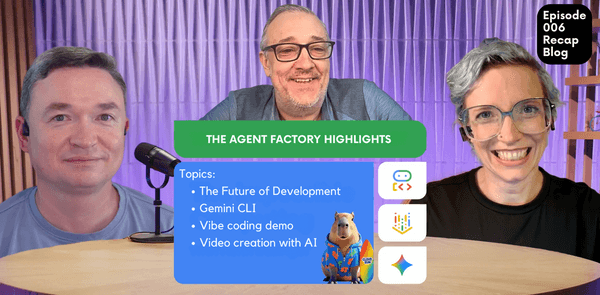
In Episode #6 of the Agent Factory podcast, Vlad Kolesnikov and I were joined by Keith Ballinger, VP and General Manager at Google Cloud, for a deep dive into the transformative future of software development with AI. We explore how AI agents are reshaping the developer's role and boosting team productivity. This post guides you through the key ideas from our conversation. Use it to quickly recap topics or dive deeper into specific segments with links and timestamps. Keith Ballinger on the Future of Development What is "Impossible Computing"? Timestamp: [01:51] Keith Ballinger kicked off the discussion by redefining a term from his personal blog: "Impossible Computing." For him, it isn't about solving intractable computer science problems, but rather about making difficult, time-consuming tasks feel seamless and even joyful for developers. He described it as a way to “make things that were impossible or at least really, really hard for people, much more easy and almost seamless for them.” AI's Impact on Team Productivity Timestamp: [05:03] The conversation explored how AI's impact extends beyond the individual developer to the entire team. Keith shared a practical example of how his teams at Google Cloud use the Gemini CLI as a GitHub action to triage issues and conduct initial reviews on pull requests, showcasing Google Cloud's commitment to AI-powered software development. This approach delegates the more mundane tasks, freeing up human developers to focus on higher-level logic and quality control, ultimately breaking down bottlenecks and increasing the team's overall velocity. The Developer's New Role: A Conductor of an Orchestra Timestamp: [09:57] A central theme of the conversation was the evolution of the developer's role. Keith suggested that developers are shifting from being coders who write every line to becoming "conductors of an orchestra." In this view, the developer holds the high-level vision (the system architecture) and directs a symphony of AI agents to execute the specific tasks. This paradigm elevates the developer's most critical skills to high-level design and “context engineering”—the craft of providing AI agents with the right information at the right time for efficient software development. The Factory Floor The Factory Floor is our segment for getting hands-on. Here, we moved from high-level concepts to practical code with live demos from both Keith and Vlad. Showcase: The Terminus and Aether Projects Timestamps: [21:02] and [28:17] Keith shared two of his open-source projects as tangible "demonstration[s] of vibe coding intended to provide a trustworthy and verifiable example that developers and researchers can use." Terminus: A Go framework for building web applications with a terminal-style interface. Keith described it as a fun, exploratory project he built over a weekend. Aether: An experimental programming language designed specifically for LLMs. He explained his thesis that a language built for machines—highly explicit and deterministic—could allow an AI to generate code more effectively than with languages designed for human readability. Vibe Coding a Markdown App Timestamp: [31:41] Keith provided a live demonstration of his vibe coding workflow. Starting with a single plain-English sentence, he guided the Gemini CLI to generate a user guide, technical architecture, and a step-by-step plan. This resulted in a functional command-line markdown viewer in under 15 minutes. Creating a Video with AI Timestamp: [47:13] Vlad showcased a different application of AI agents: creative, multi-modal content generation. He walked through a workflow that used Gemini 2.5 Flash Image (also known as Nano Banana) and other AI tools to generate a viral video of a capybara for a fictional ad campaign. This demonstrated how to go from a simple prompt to a final video. Inspired by Vlad's Demo? If you're interested in learning how to build and deploy creative AI projects like the one Vlad showcased, the Accelerate AI with Cloud Run program is designed to help you take your ideas from prototype to production with workshops, labs, and more. Take the next step and register here. Developer Q&A Timestamp: [56:37] We wrapped up the episode by putting some great questions from the developer community to Keith. On Infrastructure Bottlenecks for AI Workloads Timestamp: [56:42] Keith explained that he sees a role for both major cloud providers and a "healthy ecosystem of startups" in solving challenges like GPU utilization. He was especially excited about how serverless platforms are adapting, highlighting that Cloud Run now offers GPUs to provide the same fast, elastic experience for AI workloads that developers expect for other applications. On Multi-Cloud and Edge Deployment for AI Timestamp: [58:16] In response to a question about a high-level service for orchestrating AI across multi-cloud and edge deployment, Keith was candid that he hasn't heard a lot of direct customer demand for it yet. However, he called the area "untapped" and invited the question-asker to email him, showing a clear interest in exploring its potential. On AI in Regulated Industries (Finance, Legal) Timestamp: [59:13] Calling it the "billion-dollar question," Keith emphasized that as AI accelerates development, the need for a mature and robust compliance regime becomes even more critical. His key advice was that the human review piece is more important than ever. He suggested the best place to start is using AI to assist and validate human work. For example, brainstorm a legal brief with an AI rather than having the AI write the final brief for court submission. We concluded this conversation feeling inspired by the future of AI in software development and the potential of AI Agents and the Gemini CLI. For the complete conversation, listen to our full episode with Keith Ballinger now. Connect with us Keith → GitHub Vlad → LinkedIn Mollie → LinkedIn